The Talent Factories: Which Franchises Actually Know How to Build a Star From Scratch
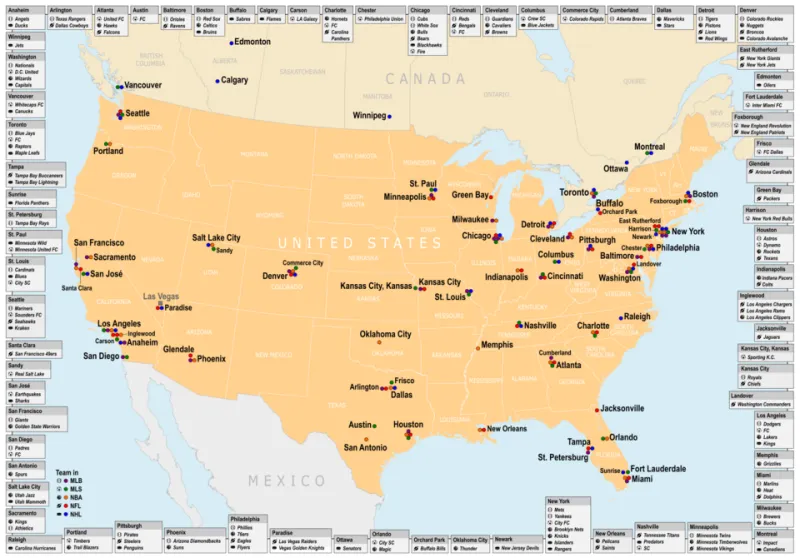
Photo: Lencer, CC BY-SA 3.0, via Wikimedia Commons
Every team goes into draft day with the same hope: find the next great one before anyone else figures out he's great. But hope doesn't develop players. Coaching staffs do. Front offices do. Culture does. And when you look closely at which organizations consistently turn draft picks into impact contributors — and which ones watch those same picks flourish somewhere else — the gap between the best and the rest becomes pretty striking.
These are the franchises that have turned player development into a competitive advantage, across three of America's biggest sports leagues.
The NBA's Gold Standard: San Antonio's Blueprint
It feels almost redundant to start here, but ignoring the San Antonio Spurs in any conversation about player development would be like leaving the Beatles off a list of influential rock bands. For the better part of three decades, the Spurs turned late picks, overlooked prospects, and international unknowns into foundational pieces of one of the most successful franchises in NBA history.
 Photo: San Antonio Spurs, via athlonsports.com
Manu Ginobili went 57th overall in 1999. Tony Parker was a teenager from France taken 28th. Kawhi Leonard was a quiet kid from San Diego State who didn't look like a future Defensive Player of the Year. The Spurs found them, shaped them, and got the absolute most out of every one of them.
The formula? It starts with coaching. Gregg Popovich built a system that valued intelligence, spacing, and unselfishness — qualities that tend to amplify whatever physical gifts a young player already has. The Spurs also invested heavily in their coaching staff and support personnel long before most teams treated those roles as important. The result was a pipeline that made mid-round picks look like steals year after year.
The current Oklahoma City Thunder, loaded with first-round picks and boasting one of the youngest rosters in the league, look like they're attempting something similar — building quietly, developing patiently, and trusting that the work will show up eventually.
The NFL's Quiet Factory: Kansas City's Second-Round Secret
The Kansas City Chiefs have won multiple Super Bowls, but the part of their operation that doesn't get enough credit is how consistently they squeeze value out of mid-round picks. Patrick Mahomes was a first-rounder, sure. But look deeper at the roster that surrounds him.
 Photo: Kansas City Chiefs, via wallpapers.com
Travis Kelce? Third round. Tyrann Mathieu signed as a reclamation project. Chris Jones was a second-round pick who became one of the most dominant defensive players in football. The Chiefs have built a culture where players who arrive as raw or undervalued prospects tend to develop into contributors, and sometimes into stars.
General Manager Brett Veach and the coaching infrastructure Andy Reid has built deserve enormous credit. Reid's offensive system is notoriously player-friendly — it finds ways to use what a player does well rather than forcing them into a rigid mold. That flexibility is a massive development tool. Young players can grow into the system rather than being broken by it.
The Philadelphia Eagles have shown a similar tendency in recent years, particularly on the offensive and defensive lines, where they've turned mid-round picks into Pro Bowl-caliber players through elite position coaching and a physical culture that rewards effort over flash.
MLB's Best Developer: The Tampa Bay Rays Do More With Less
No franchise in professional baseball has a longer track record of extracting maximum value from draft picks with minimal resources than the Tampa Bay Rays. Operating in a small market with one of the lowest payrolls in the sport, the Rays have had no choice but to be extraordinary at development — and extraordinary is exactly what they've become.
 Photo: Tampa Bay Rays, via assets.stickpng.com
The Rays have consistently produced pitchers who arrive with raw arms and leave with refined arsenals. Their analytics-driven approach to pitch design, mechanics, and usage has turned prospects into contributors and journeymen into rotation pieces. Blake Snell won a Cy Young in Tampa. Tyler Glasnow became an ace there. Wander Franco was considered one of the most polished hitting prospects in recent memory, and the Rays were the ones who cultivated that talent.
What makes Tampa's model particularly impressive is its repeatability. When players leave — and they often do, because the Rays can't afford to keep them — the machine just produces the next one. It's less about any single star and more about a system that works regardless of who's in it.
The Atlanta Braves deserve an honorable mention here. Their domestic and international scouting operation, combined with a player development staff that has consistently refined young hitters and pitchers, has kept them competitive even through roster turnover. Ronald Acuña Jr., Spencer Strider, and Michael Harris II didn't become stars by accident.
What Separates the Best From the Rest?
There's no single answer, but a few threads run through every franchise that does this well.
Coaching continuity matters enormously. Players develop faster when they're not learning a new system every other year. The franchises that retain good assistants and invest in their development staffs tend to see better results from young players.
Culture is harder to quantify but impossible to ignore. Teams where veterans model professionalism and younger players are held to real standards tend to accelerate development. The Spurs were famous for this. The Chiefs have it. The Rays have built it despite operating in a market that makes everything harder.
Patience is the most underrated ingredient. The franchises that resist the urge to rush young players — or to give up on them after a slow start — consistently get more out of their investments. Development is rarely linear, and the organizations that understand that tend to be the ones whose late-round picks show up in All-Star Games five years later.
Draft day gets all the headlines. But the real work happens in the months and years after the picks are made — in practice facilities, film rooms, and conversations between coaches and players that nobody ever sees. The best franchises know that. And their championship banners prove it.